Sunday, 16 May 2021

I Struggle With Words

My life is in words, not all of them beautiful, not all of them needed. But some of them thread me together like this poem by Sharon Olds:

    I cannot say I did not ask 

    to be born.

Yesterday, I proofread the manuscript for my forthcoming chapbook - GREAT MASTER / small boy (Fair Acre Press). I find this a nerve-wracking process, even though all is yet possible, nothing has been committed to print. I wrote the sequence in 2018-19 after travels to Germany and Austria with my son Jonty in search of Beethoven. "The trouble is," I said to Gabriel, his older brother, on our walk in the rain yesterday after dark, "I want it to be perfect." The book is, in its essence, a gift for Jonty (its publication date is his 21st birthday) - it's an account of that geographical journey, but of so much more too. As Andrew McMillan has written in his back cover endorsement, "...love of music is always a journey ... towards love."

     Before I existed, I asked, with the love of my

    children, to exist ...

This past year I have not been able to write much, or rather, I haven't been able to write much new poetry. I've written here from time to time. (Thank goodness for this blog, and the book that's come from it - so much pleasure there, and the kind reading and sharing of it). And I've written thousands of emails, texts, even posted the odd tweet ...I've written for my job as a university lecturer: thousands and thousands and thousands of words about, well, about how and why we can and must care for and empower each other, about how we try to learn when we cannot be together. That work has been utterly exhausting, though I regret none of it. 

As for the music of poetry? The place from which that comes feels numbed, weary, tuneless. 

    I asked, with everything I did not

    have, to be born. And nowhere in any

    of it was there meaning ...


I woke this morning and after a bit of Sunday morning laying around, talked with myself about first things - about how I came to write poetry in the beginning, how I scribbled lines, hid them and tore them up, then eventually had the courage to join a writing group in my 40s. It was through reading poetry, not writing, that I found what I needed to know. After the reading, the writing - the impetus to express my own longings. I knew, I reminded myself decades later, that it was reading The Wasteland in my 1980s London bedroom that convinced me that I was not alone.

Sharon Olds, in her poem I Cannot Say I Did Not addresses the question of unbidden existence more clearly than anything I've heard or read in any other context: church, family, school, social work text books, The School of Life website ...  This existential conundrum haunted my youth -  none of us asked to be born. Olds takes it head on in this poem, even daring to end on a preposition. It's brilliant, and reading it again this morning (from the Bloodaxe Staying Human anthology) it confirmed to me that if I turn back to reading the poetry that moves me most, poetry which is about this existence of ours - the one that we've been hanging onto for dear life - if I turn back to the well-worn pages of Olds, Rich, Hopkins, Eliot, Collins, McMillan, Clarke, Sprackland, Duffy, Oliver ...  in time, and with gentleness, and quietly, I will find my voice again.

    ... I want to say that love

    is the meaning, but I think that love may be

    the means, what we ask with. 


Sharon Olds - I Cannot Say I Did Not


Sunday, 2 May 2021

I Review A Pamphlet - Lucy Rose Cunningham's 'For Mary, Marie, Maria'

For Mary, Marie, Maria

after the nectar, pyre and linden tree

Lucy Rose Cunningham

Broken Sleep Books –

Purchase here:

https://www.brokensleepbooks.com/product-page/lucy-rose-cunningham-for-mary-marie-maria


Reviewed by Liz Lefroy


I read Lucy Rose Cunningham’s recently published sequence sitting on a bench in a country graveyard this afternoon, with memorial stones in the foreground, and the Shropshire hills in the long view. I had a flask of Earl Grey and a bun to keep me company. My bicycle was propped next to me against the wall of the church. I was glad I’d set the context to become acquainted with this beautifully produced pamphlet from Broken Sleep Books. All credit to the publishers for its austere elegance.

I’ve learnt to look after my body as I’ve aged – in Cunningham’s Acknowledgements words – to know what this body really deserves. It’s an important rite of passage, and one to which Mary, Marie and Maria all have something to contribute. Others have illuminated this aspect of Cunningham’s work, so  I won’t repeat what they’ve written (I refer you, for example, to the Cardiff Review https://www.cardiffreview.com/review/a-rich-stirring-debut-for-mary-marie-maria/ )

For my part, I chose this setting for reading because I wanted to listen hard to Cunningham’s voice – not to understand every line (I didn’t) but to loosen up, pay close attention to what I heard and felt. I found much to enjoy, and much to grieve, in doing so.

Cunningham’s work resembles in so many ways what I first came to love in poetry as a very young woman (in Eliot, Hopkins, Keats, et al). It has space, subtlety, depth, originality.  Cunningham creates a soundscape which is both rich and spare, tender and fierce. Her writing is free from clamour, and uses imagery which is both familiar and sits skewed on the page. Behind each phrase, however taut the surface, is a softness which would bruise, were it gripped too hard:

              of simmered tea leaves and wicks,

              candles drunk with butter

              wax waning, as she waited

It is this tenderness, this open-heartedness, which gives the work its youthfulness. Here is a fresh voice which leaves traces on each page of that sense of being at the beginning of things, even though “I’m running out of spoons” (IV – Spoon theory). My reader self is grateful to Cunningham for her uncontrived authenticity which connects me with my young self in ways which took me right back to

[it’s] this aching thought,

the impress of Love of ache of thought

in my bedclothes,

At the end of my reading, I packed up my things and climbed back onto my bike. As I cycled home, I found myself filled with thoughts of my young body, my young self, the voice it didn’t have, the way it dared not speak. Cunningham’s voice speaks for her, in some ways, and that is reason enough to return to that bench, these poems again, one day soon.


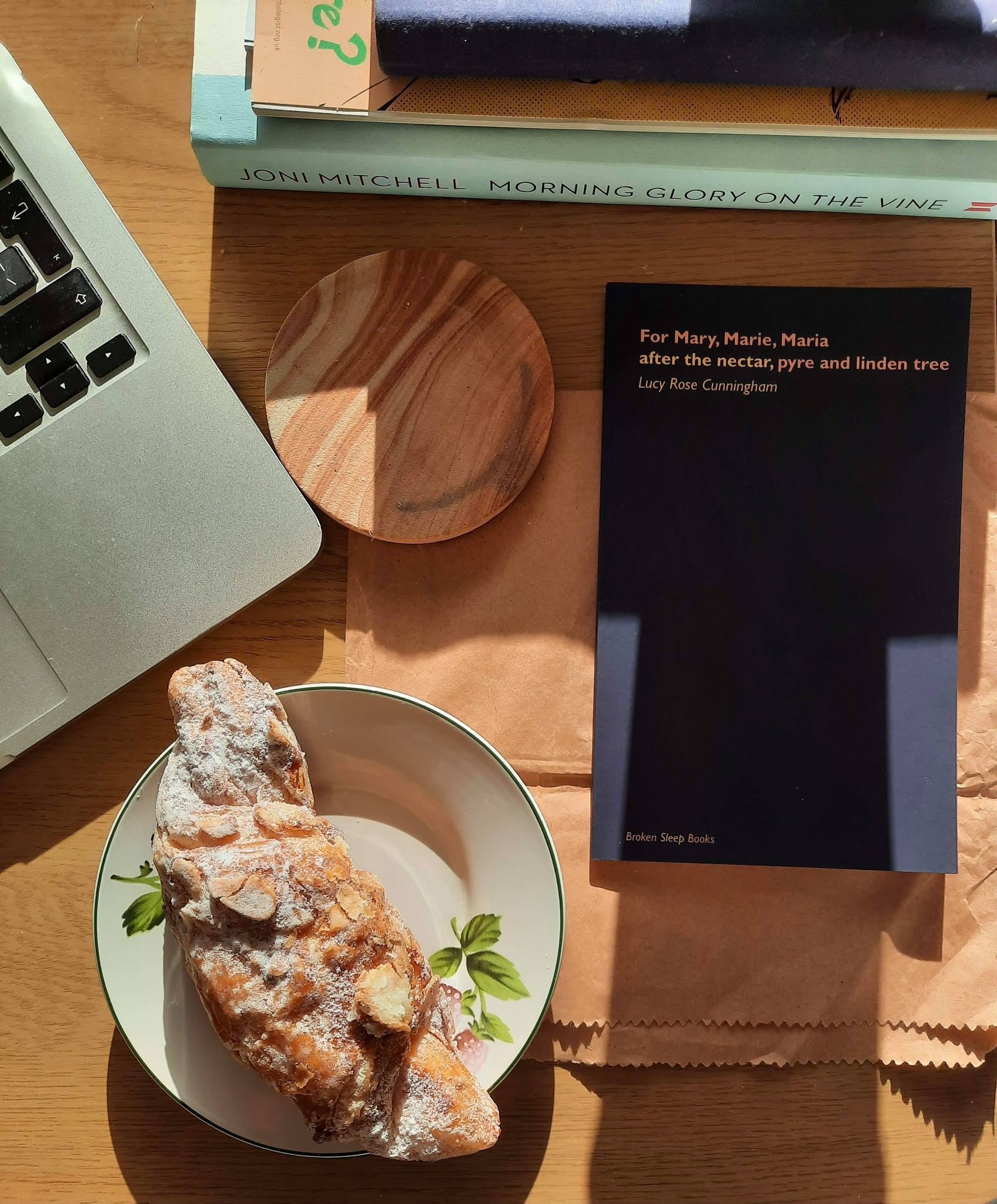
Mary, Marie, Maria (with almond croissant)  
© Ellie Milne


                                                Lucy Cunningham

Sunday, 28 March 2021

I Census Myself

'When I feel like that, I ask myself what would a young, white, confident man in tech ask for? ...' is the best advice I've been given in March. It helped me to leave a couple of the questions on the recent census unanswered, and to launch my Facebook page this week. 

Questionnaires, however well-designed, try to squeeze us (in the case of the UK census, all 66.65 million of us) into boxes. I'm averse to small spaces unless they are ones I step into of my own accord, zipping up the flap behind me. But it's mandatory to submit the 2021 census, so I clicked the required boxes on the online form last Sunday and pressed Send. 

The same day, I created a Facebook page in an attempt to offset some of the challenges of publicising a new book at a time when the pandemic has made the usual readings in bars, cafes, and libraries impossible. At an event pre-lockdown, I might sell 5 books following one of these (usually) free events, sometimes more, occasionally none. I offered a discount, signed the books as requested. It was a good exchange all-round.

The questions I didn't answer on the census were about religion and sexual orientation. In writing this, I have already given you more information than the National Office of Statistics will receive about me. Perhaps I was influenced by the recent graffiti (graffito?) I saw near the station which reads, JESUS WAS BISEXUAL. How odd, I thought, to choose that as a daub, but then again, it did get me thinking. So too the other graffito under the railway bridge: GREAT NESS IS BORING. How odd, I thought, to condemn a hamlet near Nesscliffe so specifically, and to travel ten miles or so into town to do so.  

Questions about sexual orientation are even less conducive to box-ticking than questions about religion. Under each of these census questions I clicked Why we ask this question to find out how it could be relevant, was told it will help the design of services. I simply do not believe this. What will help with the design of services is the campaigning work of organisations like SAND . The negative impacts of labelling continue: 'heterosexual', 'gay', 'lesbian', and 'bisexual' are not terms of equivalent meaning or stigma when we're standing up to be counted. I would daub that somewhere if it wasn't so long (when does graffito become graffiti?) and against the rules. 

One of the hesitations I felt about launching my Facebook page was that I had to think about which categories of people might like my work. The categories don't include those who don't like books: I've already been told. Aside from that, it's hard to be sure enough to tick boxes, although there has been a particular interest shown by people who went to Durham University, though that doesn't include a scattering of keen readers in Australia. Except for Penny. 

My main reluctance, however, was that, as I said to my young advisor, promoting my book feels like asking for money. 'When I feel like that,' she said, 'I think: what would a young, white, confident man in tech ask for?' And buoyed up by her refreshing, honest courage, but not in pursuit of greatness (which is *ohhhhh! that's what it means* boring) I pressed Go.


Drawing copyright John Rae

I Text The Poet Laureate

From - I Buy A New Washer - Liz Lefroy (2020) Mark Time Books


Sunday, 14 March 2021

I Mother - We All Need Mothering

Mothering Sunday is celebrated today in the UK. There are some important points to note about this tradition - mainly that it's not, in its origins, all about being, or having, a mother, even if that has become its focus more recently. 

On Mothering Sunday, in the 16th century, Christians visited their mother church - their spiritual home. This was the church in which they were baptised. For me, this would be All Souls, Langham Place, London.

The connections between Mothering Sunday and mothers became clearer in the 1910s and '20s when (as Wikipedia puts it) Constance Adelaide Smith (not a mother herself) 'reinvigorated' Mothering Sunday in the British Isles, having heard of the way Mother's Day was introduced to celebrate the role of mothers in the USA. Rather than adopting a new festival, Smith amalgamated aspects of Mother's Day with Mothering Sunday and promoted it in her published works. Having stuck with Mothering Sunday, it means the day we celebrate motherhood isn't fixed - it moves with the ecclesiastical calendar: is always on the fourth Sunday in lent, mid-way between Ash Wednesday and Easter. 

Ahh Lent! The time for extra self-discipline. But even the church recognises we all need a break sometimes. So the first aspect of a traditional Mothering Sunday is that it is a legitimate break from fasting. I note this for my friend, who has birthday cake to finish up, and for my son, with whom I hope to do some baking later on. 

The second aspect of a traditional Mothering Sunday is that you don't have to be a mother, or to have a surviving mother, to mark it. We aren't told this - instead we're told that if we are bereaved or childless we can opt out of the flurry of marketing emails selling us Mother's Day merchandise. Big deal.

Many of us no longer have a mother church, or a mother place of worship from any religion. My parents left the west end of London when I was 6 months old, so my emotional connection with it as a place is close to none. I've needed to find a new way of homecoming, or mothering, being mothered. The Macmillan dictionary definition of mothering helps - it says that mothering is to treat someone with care and kindness as though they were a small child. 

According to this definition we can all mother and be mothered today - in fact, it's essential human behaviour, and transcends biological sex, gendered expectations, labels, and doing the washing up. We can all be 'as though' small children, especially now in this pandemic when we are  experiencing huge losses, so tired, downhearted, in a strop, miserable, over-wrought, anxious ... 

Sometimes, I forget to mother myself. I get lax about bedtime, about reading to myself, about baking. Sometimes, I forget how much we all need mothering.

Today, I am lucky enough to be able to lie around and read a book, then later, maybe I'll get my crayons out and draw myself a card. I'll bake with my son as part of a celebration not so much of motherhood, but of the human capacity to show care and kindness at a time when we all need to be, from time to time, given flowers, fed cake, encouraged to splash in puddles, hugged, listened to without judgement, reminded to lie down and rest, pretending to be a dozing cat: treated as if we were small children. 


Photograph © Mike Powell 


Saturday, 27 February 2021

I Grieve Simply

In spite of the lockdown restrictions, mourning my friend Joyce Brand, who died on 18th February, is a simple grief. Joyce was a good and wise friend, and I want to acknowledge, in this small space, something of the huge impact she had on my life, and my gratitude to her. 

I loved Joyce. I loved her company. I miss it. I will go on missing her. Like this grief, our friendship was also straightforward, and it was enacted in good conversation based in shared values. 

We enjoyed many such conversations in the company of her many friends in various situations over the years - weddings, dinner parties, book readings, social work classrooms. These occasions were always fun, but it's the memories of the one-to-one times with her I treasure most. Having Joyce's full attention was a privilege. If you were lucky enough to experience it, you will know what I mean. 

When I think of Joyce, I think of her smiling to welcome me into her home. She moved several times in the twenty or so years of our friendship, always thinking ahead, planning, downsizing to her final home in Ludlow a few years ago. If only we all had such an instinct for the obvious need to become increasingly grounded. It helped that she liked moving.  

When I think of Joyce, I think of sitting in an armchair as she went to make tea. She'd bring in a tray loaded with cups, saucers, teapot, milk jug, and cucumber sandwiches on a pretty china plate. Latterly, she'd wheel in a tea trolley. We talked of what was in the news, what we were reading or watching, of the benefits of an early afternoon nap. Theses talks were sprinkled with whole-hearted laughter, happiness, and a generous dash of hilarious derision for those at the centre of the latest political scandal.

Joyce treated me as an equal, but we weren't. It was right that I looked up to her: older, wiser, smart as a button. I was usually hungry for guidance about a stage of life, or a work situation, that she had already negotiated. When we reached that personal territory, she would help me to see more clearly how to navigate it kindly, and as myself. 

Joyce, who enjoyed the company of men enormously,  set no store by the cultural and enduring narrative that we women need a man to complete our lives. She lived independently, independent, surrounded by friends who came and went from her home, bringing conversation, freshly dug potatoes, crossword tips, and the ability to move furniture, or put up shelves. There was a realism in Joyce's advice. "Do you have a pension?" she'd ask, out of concern for my future self. She knew that independence is a reality born out of practicalities, not simply a frame of mind. 

When I published a book at the end of last year, I knew I wanted Joyce's name on the back cover. Her endorsement, when it came, felt like an old-fashioned blessing: her hand laid on my bowed head. It was a moment of approval I will hold close in the coming weeks. 

At the end of those one-to-ones, after we'd chatted for a couple of hours, I'd leave her company, thinking, "When I grow up, I want to be like Joyce." 

I still do. 


Read more about Joyce here:

https://www.shropshirestar.com/news/local-hubs/south-shropshire/ludlow/2021/02/23/she-made-a-real-difference-ludlow-health-campaigner-joyce-brand-dies-at-86/


Sunday, 14 February 2021

I Set A Breakfast Tray

My grandmother used to correct me: "It's set. You set a table. Hens lay eggs." 

I think this insistence on the verb set being the correct way to describe the arrangement of cutlery, glasses, etc. might be named a shibboleth: a characteristic principle, often outdated, of a group that distinguishes it from another group, or class. 

It felt, when she emphasised set, as if Granny were hanging on to something for dear life.

This grandparental voice is clear in my head whenever I prepare to serve a meal. I still set tables, cannot do anything else, and, this morning, it being Valentine's Day, I set a tray with teapot, jug, plate, glass, and mug, ready for breakfast in bed.


I selected the teapot first, 50th birthday gift from my Longest-Serving Friend. I spooned in equal measures of English Breakfast and Earl Grey loose leaf tea. 

Next, the tiny milk jug, just enough for one, a present from Charlotte. It comes from the Emma Bridgewater factory in Stoke-on-Trent where she and I used to, and will again, meet regularly for tea served in their patterned mugs, large slices of cake, and meanderings round the factory shop. I miss her, our long and easy catch-ups, spiced with giggles. 

The plate is also Emma Bridgewater: one I bought myself in an on-line payday spree last autumn. Toast tastes better when eaten from a plate whose colours complement strawberry jam. 

The glass, filled with freshly-squeezed blood orange juice, is one I bought from IKEA in Antwerp. They can be bought from IKEA anywhere, but this one is a souvenir from the seven trips I made there to see my son over the three years he lived there: trips which came to an abrupt end with the pandemic.

Finally the mug, lovely gift from Mike. Last night, I wondered darkly how long I have to go without writing a poem before I stop being a poet. This morning, preparing a Valentine's breakfast for one, this was the obvious mug to choose. 

I sat in bed this morning in the company of crockery, eating toast, drinking orange juice. Three times, I poured milk from the tiny jug into the mug-of-affirmation, before pouring on the English Breakfast / Earl Grey mix. With each mugful, I felt the warmth of love, in all its richness and many forms, grow stronger.  

Sunday, 7 February 2021

I Phone A Friend

I phoned Bob this week, after years of thinking about him, sending and receiving Christmas cards. Happily, joyfully, he's well, in his 90s now. North London's still audible in his vowels, although he moved away, as I did, years ago.

When we met, I was 5 or 6 years old, and he was around 40. He had been widowed: devastated by the death of his first wife, and turned up at my father's church, looking for consolation. I was bored, hanging around, at a loose end while something was going on: prayer, singing, meeting, adults chatting - something a 5-year-old couldn't, or wouldn't, share. 

There I was, small, awkward for my age, idling, waiting (it turns out) for a hand to hold -  metaphorically, emotionally, psychologically, and literally. 

"I noticed you," Bob recalled towards the end of our conversation, "and prayed that you would come and hold my hand. And you did." 

I thought, momentarily, of naming this blog I Answer A Prayer, but my views on prayer are complicated. I realise this is one of the reasons I haven't phoned Bob for so long. I didn't want him to be disappointed that I've turned out poet, not angel. 

In c.1969, Bob and I, separated by a generation, were attuned to each other in the way that human beings can sometimes be, despite the gaps between us. His prayer a call, my response a sense that here was someone safe. What did we notice in each other? Gesture, tone of voice, openness? 

After our phone call, I know that Bob understands, looking back, that I needed his care as much as he needed mine, and, we spoke of this for the first time. "Your father was very disciplined," he understated.

 He prayed. I walked over, took him by the hand, hung on. 

I loved Bob, and for a year at least, we used to sit together in a pew at the back left-hand side of the church each Sunday. I can picture my young self, all unbrushed hair and hand-me-down clothes, walking through the west door and up the aisle. I'd see the back of Bob's head and run the last steps to join him. He was always in a suit, shirt pressed, hair neat, tie tied, shoes polished. He was never late, never missed a Sunday, never passed judgement on my disheveled appearance. I sat next to him during the interminable services, small and fidgety, comforted by his presence.  

When I was older, 7 I think, I joined the choir, and suggested to Bob that he married Vera, though I'm now sure he'd already had the idea himself. They married, and Bob moved into the flat at the bottom of the vicarage where Vera lived. They often looked after me and my brothers when my parents were busy, and didn't complain about us jumping down the stairs onto their ceiling, riding our bicycles through their washing. 

Bob and Vera were lovely together: for more than twenty years till her death, they found happiness in each other, and a shared way of being. They illuminated the years of my childhood with kindness, cheerfulness, creativity, and play.  

When Bob and I finished our conversation I cried a little, feeling both loss and a sense of exhilaration. The connection between a sad young man and a little girl, albeit five decades ago in another dimension, is still real and it is still comfortable. 

What will survive of us is love.


Photo - Mike Powell

What will survive of us is love is the final line of Larkin's poem 'An Arundel Tomb'